DESIGN STRATEGY

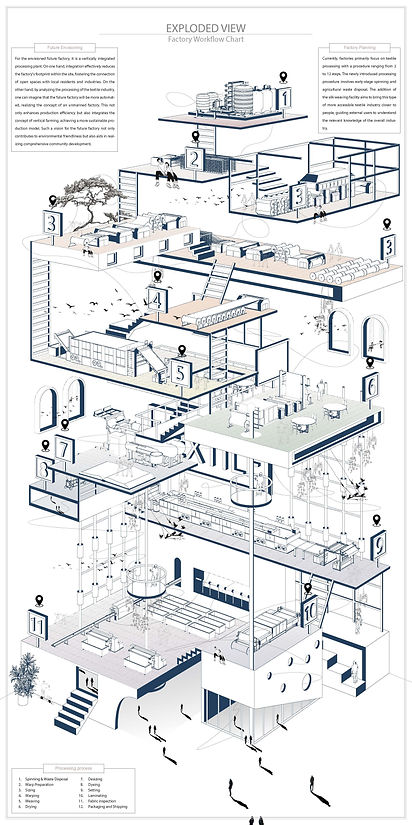
延續紡織廠的標準流水線配置概念維持工廠基本運作,拆解原為一體的廠房建築重新排列,並將原先的大廣場空間碎化置換成各個廠房之間的緩衝空間,讓緊密的建築群擁有喘息的機會。 串聯東西向田野的建築群,從兩側開始到中間低至高的高程配置配合綠化形成生態跳島,提供候鳥與微生物更多的棲地空間。 美食廣場及咖啡廳的機能作為親近常民的一般日常生活場域,並將旅館、織品實驗室、軟裝家居工作室配置在小基地,一步步引導居民接觸織品,走進工廠。 利用地下化及垂直化手法減輕地面層量體體積,且同時保有地面層生活空間的延續性,參觀者可以依循加工流程接觸不同面向的工廠。東側鄰田的腳踏車步道能駛入基地內,一路西向通往天橋旅館方向。 解放工廠極致效率的同時,誠實地面對環境問題,針對各廠房特質對加工流程的環境問題進行獨立改善,配合量體不同的構築操作與自身水系統循將汙染降至最低。 Continuing the standard assembly line configuration concept of the textile factory to maintain the basic operation of the factory,The factory buildings that were originally integrated were dismantled and rearranged, and the original large square space was fragmented and replaced into buffer spaces between the factories, giving the tight building group a chance to breathe. The buildings that connect the east-west fields are arranged in low to high elevations from both sides to the middle and combined with greening to form an ecological island hopping, providing more habitat space for migratory birds and microorganisms. Food courts and cafes function as areas of daily life that are close to ordinary people. And arrange the hotel, fabric laboratory, and soft decoration home studio in the small base. Guide residents step by step to get in touch with fabrics and enter factories. The underground and vertical methods are used to reduce the volume of the ground floor while maintaining the ontinuity of the living space on the ground floor. Visitors can follow the processing process and contact different aspects of the factory.The bicycle trail in the neighboring fields on the east side can be driven into the base, and all the way to the west leads to the Tianqiao Hotel. While liberating the ultimate efficiency of the factory, it also faces environmental issues honestly, independently improves the environmental issues of the processing process according to the characteristics of each factory, and cooperates with the different construction operations and its own water system circulation to minimize pollution. The desizing plant is configured below the ground floor. Taking into account the height of the machine and the overhead space on the first floor, combined with the curved ceiling device, the design of the plant can guide the hot air emitted by the machine to be discharged from the space on the first floor, affecting the upper-floor viewing platform. sense of space. As for the tour route located underground, because the hot air is discharged from the first floor, through the principle of air convection, the temperature at a location closer to the machine is lower than that of other spaces on the upper floor.

Textile factory system
整體紡織系統架構分成主要八個階段流程操作廠房設計,分別為廢料纖維抽取、紡紗、整併經(製胚布)、烘乾、退漿、染整、定型膠合、驗布。 廢料來源為當地居民成衣回收及農業廢棄物為主 The overall textile system architecture is divided into eight main stages for process operation plant design.They are waste fiber extraction, spinning, finishing and warping (grey cloth making), drying, desizing, dyeing and finishing, shaping and gluing, and cloth inspection.` The sources of waste are mainly local residents' garment recycling and agricultural waste.
紡織工廠系統架構
空間概念轉化
Space concept
分解布匹在各項加工過程中的行為變化,再將其轉化成對各個流程的空間想像,進而結合工廠既有的限制整合空間。最後針對廠房內的環境問題操作構築加以改善,讓使用者能藉由建築本身的語彙及構築型態去了解工廠運作。
Decompose the behavioral changes of cloth during various processing processes, and then transform them into spatial imagination of each process, and then integrate the space with the existing limitations of the factory. Finally, the operational structure of the factory was improved to address environmental issues, allowing users to understand factory operations through the vocabulary and architectural form of the building itself.

將布匹型態轉化成空間概念模再進行後續空間想像
Convert the cloth form into a spatial concept model and then carry out subsequent spatial imagination.
01 / 纖維抽取 - 結網、拉張
Fiber extraction
以結網拉張的操作手法操作纖維抽取空間,並將此定義為生活場域,相較於其他行為空間更具公共性,大眾能在其中一窺紡紗加工過程,體驗漿農藝廢棄物變成紡織原料的同時,感受田野的連結。畫面利用拉張成面的視覺效果去支撐上方的廠房空間,是我們對於工廠存在的態度,也許未來工廠不再像現今一樣笨重,而是以更輕巧柔和的形式交織在我們生活中。 The fiber extraction space is operated by the method of knotting and stretching, and is defined as a living field. Compared with other behavioral spaces, it is more public. The public can have a glimpse of the spinning process and experience the transformation of pulp agronomic waste. While turning into textile raw materials, you can feel the connection with the fields. The picture uses the visual effect of stretching into a plane to support the factory space above, which is our attitude towards the existence of factories. Maybe factories in the future will no longer be as bulky as they are today, but will be intertwined in our lives in a lighter and softer form.

.jpg)
02 / 紡紗 - 萃取、撚合
Spinning
透過分析既有工廠,萃取其中精華,並加入對於未來工廠的期待,將兩者重整撚合創造出更貼近人性的廠房空間。去蕪存菁後的空間平面能衍伸出不同的機能,透過小尺度的解構手法,引領參觀者探索深層的紡紗世界。 By analyzing existing factories, extracting their essence, and adding expectations for future factories, we reorganize and combine the two to create a factory space that is closer to humanity. The spatial plane after removing the essentials can derive different functions. Through small-scale deconstruction techniques, visitors can be led to explore the deep world of spinning.
03 / 製胚布 - 排列、成面
Weaving
整經、漿紗、併經和織布廠房以排列成面的操作形式交錯配置,提高作業行為感官和系統上的互動,同時兩個空間之間的模糊地帶,可減輕機器與廠房空間帶來的壓迫,並改善室內工作環境品質。而下沉式開放空間為居民的生活場域,使其能降低工廠對其的影響。 The warping, sizing and weaving workshops are staggered in an array of operations to enhance sensory and system interaction. At the same time, the fuzzy zone between the two spaces can reduce the impact of the machine and workshop space. pressure and improve the quality of the indoor working environment. The sunken open space serves as the living area for residents, which can reduce the impact of the factory on it.
.jpg)
.jpg)
04 / 烘乾 - 變質 循環
Drying
以水的三態變化及循環為概念,透過量體實虛、框架等元素轉化。廠房產生的水蒸發成霧氣瀰漫在場域中,營造靜謐的氛圍,替工廠既有的厚重空間結構增添輕巧感。而居民的生活場域提高至上層,使其氛圍得以延續,讓使用者能感同身受。 Taking the three-state changes and circulation of water as the concept, it is transformed through elements such as volume, reality, and frame. The water generated in the factory building evaporates into mist and fills the area, creating a quiet atmosphere and adding a sense of lightness to the existing heavy spatial structure of the factory. The living area of the residents is raised to the upper level, so that the atmosphere can be continued and users can feel the same.
05 / 退漿 - 收縮、震動
Desizing
天頂整合了生活與廠房區,使整體呈現半開放場域。階梯型式的地平操作,因應被覆蓋的天際線,引導使用者往地下探索。廠房機械產生的水氣經過加工處理轉化成霧氣,使用者能在高程變化中感受霧氣的狀態轉換。 The zenith integrates the living and factory areas, making the whole a semi-open space. The stepped horizontal operation guides users to explore underground in response to the covered skyline. The water vapor generated by the factory machinery is processed and converted into mist. Users can feel the state transformation of the mist during the changes in elevation.
.jpg)
.jpg)
06 / 染整 - 擴散、附著
Dyeing
以染色過程中,染色粒子與胚布之間的關係形成概念空間。延伸而長直的挑空空間,演繹著染整的三階段變化,使 用者能穿梭於其中以宏觀的角度去了解微觀的世界。 During the dyeing process, the relationship between the dyeing particles and the fabric forms a conceptual space. The extended and straight hollow space interprets the three stages of dyeing and finishing. Users can travel through it to understand the microscopic world from a macro perspective.
07 / 定型 膠合 - 攤平、層合
Glueing
因應加工所需基本長形挑高空間,同時分析兩者加工處理手法。轉化定型的扁平形式及膠合的上下層級手法創造出概念空間。而廠房產生的水氣經過加工處理轉化成霧氣,則替工廠既有繁雜的空間與大型機具的擺設增添層次。 In response to the basic long-shaped and high-ceiling space required for processing, the two processing techniques are analyzed at the same time. Transforming stereotyped flat forms and gluing upper and lower layers create conceptual space. The water vapor generated in the factory is processed and converted into mist, which adds depth to the existing complex space and large-scale machinery and equipment in the factory.
.jpg)
.jpg)
08 / 驗布 - 卷軸、切割
Inspection Packaging
透過加工過程中布的形體變化,轉化成空間操作,同時利用直向性的挑空空間,結合出口與運輸機能的空間特色,強化整體場域流動與指向性;比喻經過一系列加工過程,到了最後階段已形成完整的布匹,準備出口。抵達這個空間代表完成所有參觀體驗,希望藉由循序漸進的過程能夠更了解工廠運作,切割以往對工廠的刻板印象。 Through the changes in the shape of the cloth during the processing process, it is transformed into spatial operations. At the same time, the vertical hollow space is used, combined with the spatial characteristics of the exit and transportation functions, to strengthen the flow and directionality of the overall field; metaphorically, after a series of processing processes, By the final stage, the complete piece of cloth is formed and ready for export. Arriving at this space represents the completion of all visiting experiences. It is hoped that through the step-by-step process, we can better understand the factory operations and break away from the previous stereotypes of factories.